Tineco Floor One S5 Review: One-Pass Vacuum and Wash for Hard-Floor Pet Homes, With an Upkeep Catch
By VacuumWiz Editorial Team · Published Oct 12, 2026 · Updated Oct 13, 2026 · 9 min read
Testers and owners ran the Tineco Floor One S5 on muddy paw prints, kibble, and tracked-in grit. One-pass cleaning holds up; the tanks and roller ask for daily care.
VacuumWiz Score
5.8/ 10
Tineco Floor One S5
Four dimensions
Cleaning performance7
Ease of use6
Everyday upkeep6
Long-haul reliability4
Verdict
This wet-dry cordless holds up on hard floors: owners with dogs, cats, and muddy entryways report it lifts tracked-in dirt and pet hair that a mop just pushes around, and the separate clean and dirty tanks keep the wash water fresh. The trade-off is upkeep and capacity: the dirty water tank is small, the self-clean cycle does not replace hand-rinsing the roller, and the tank sensor can false-alarm and shut the machine down.
When muddy paw prints cross the kitchen tile and kibble collects under the dog's bowl, a mop mostly pushes the mess around while a dry vacuum leaves the film behind. Independent testers and owners put the Tineco Floor One S5 on exactly those jobs in hard-floor pet homes, running it as the daily cleaner for weeks at a stretch. The cross-checked picture is consistent: this wet-dry vacuum vacuums and washes in one pass and genuinely replaces the mop on hard floors, but it will not touch carpet, and it asks for a cleaning routine of its own after every run.
Verified unit
Tineco Floor One S5
Wet-Dry Vacuums
A household with shedding pets and lots of hard flooring, muddy paw prints on kitchen tile, kibble scatter, tracked-in grit, that wants to vacuum and wash in one pass.
As an Amazon Associate, we earn from qualifying purchases — at no extra cost to you. Learn more
Works well
Pickup on hard floors is the verified strength here: muddy paw prints, winter salt, and sticky kitchen spots come up in fewer passes than owners expected, and the dirty tank shows the grime actually left the floor.
The self-propelled drive and tight pivoting take the strain out of pushing a wet machine, which multiple owners with large single-floor layouts called out as the reason they clean more often.
Cordless operation covers roughly a 1,200 to 2,400 square foot single-floor home on one charge when floors are kept up, so daily maintenance runs do not require planning around an outlet.
Watch out
The dirty water tank sensor is the repeating reliability pattern: owners report the machine insisting the tank is full when it is empty and clean, refusing to run until the contacts and the removable base piece are scrubbed, and one lightly used unit never recovered.
Tank capacity lags the floor area it can cover: large homes report emptying the dirty tank five or six times per session, and the self-clean cycle itself can drain the clean tank and fill the dirty one mid-run.
Edge cleaning works on one side only, so cleaning both sides of a baseboard run means turning the machine around and approaching from the opposite direction.
One-Pass Cleaning on Hard Floors

The core promise of the Floor One S5 is that a single pass vacuums and washes at once, and tester footage backs that on tile, hardwood, and laminate. Owners with dogs report muddy paw prints and winter salt coming up in fewer passes than they expected, and the proof ends up in the dirty tank, where the grime that left the floor is visible when you dump it. One tester piled debris into a heap and watched the machine clear it in a single stroke; another found that sticky or dried spots on tile respond to parking the head on the stain for a moment, then pulling back and forth. Larger debris is the exception: repeated passes over paper scraps mostly pushed them onto the brush head instead of lifting them in.
Because it washes with fresh water rather than pushing dirty water around, the floor comes up the way a hand mop never quite manages, though it does not come up dry. Testers note a slight film of water marks behind the head, and in their runs it dried within about three to five minutes. One tester with cats flagged a quirk worth knowing: the drying airflow around the brush can blow loose pet hair away from the head, so a pass sometimes turns into herding hair across the floor before it is picked up. A low doormat can get a light wash, but that is the ceiling, since carpet and area rugs are outside what this machine does.
One pass vacuums and washes at the same time.
Edges, Corners, and Low Furniture
The roller reaches close to baseboards on one side only, so cleaning both edges of a wall run means turning the machine around and coming back from the opposite direction. Owners who discovered this after buying called it workable but worth knowing up front. Corners are harder still: because the front roller has a round cross-section, one tester found blind spots right where two walls meet when approaching head-on, and tight nooks stayed out of reach.
Low furniture is the firmer limit. Multiple testers report the head cannot reach deep under beds, coffee tables, or TV stands, because the tilt angle is limited, and pushing past that angle lifts the roller off the floor or lets water leak. Under a shallow entryway cabinet one tester could poke the head in a little, so toe-kick depth is about the boundary. The machine does climb over cords and small rugs, but one tester saw collected dry debris spill back out when it bumped across them, which means a second pass to recover what it dropped.
Handling and Daily Use
At a rated 4.5 kg before water goes in, the Floor One S5 is heavier than any stick vacuum, and testers agree that carrying it one-handed, especially with the tanks filled, is a chore. On the floor the weight mostly disappears, because the self-propelled drive pulls the machine forward, and several owners with large single-floor layouts said this pull is the reason they clean more often. The catch is that the assist only works going forward. Pulling the machine backward is when you feel every kilogram, and one early tester found the forward pull aggressive enough that walking too slowly made the head stall and stop.

Day to day, three buttons on the body handle power, modes, and self-clean, a screen shows the remaining battery while you work, and voice prompts announce each step, including reminders to empty the dirty water and clean the roller when you dock it. Testers note this makes the machine easy to hand to anyone in the household. Noise is worth planning around: the unit is rated at 78 dB, and one tester compared the wash and self-clean cycles to a washing machine on its spin cycle. Owners report roughly 35 minutes of runtime on a charge, enough for a maintenance pass over a typical single-floor home, though heavy soil triggers the higher power mode and can drain the pack mid-house. Recharging is slow, so the routine is to dock it between sessions rather than expect a quick top-up.
The screen shows remaining battery while the head works.
Upkeep After Every Run
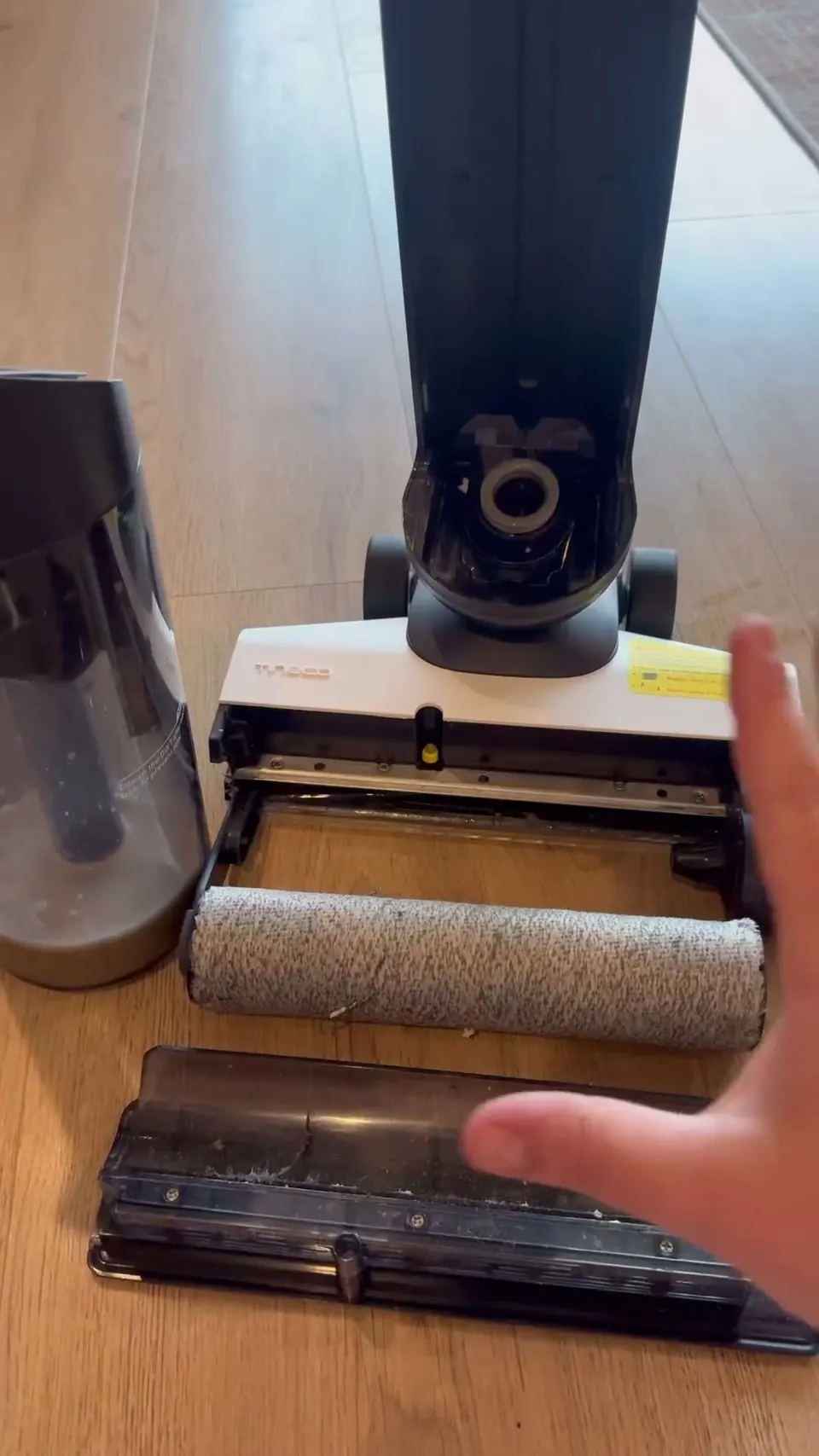
Docking the machine starts a self-clean cycle that runs about three to four minutes: it mixes a cleaning solution, washes the roller, spin-dries it, and finishes with hot air, and testers found the roller genuinely dry to the touch afterward. A spare roller and filter ship in the box, so a dry set can swap in while the used one airs out. What the cycle does not do is finish the job. Corroborated tester reports say self-clean cannot fully replace manual cleanup: hair still winds around the roller shaft and has to be cleared by hand, and owners who stay ahead of odor pull the roller to air dry and rinse both tanks after every run. A strainer in the dirty tank lid catches hair, which makes dumping the liquid quick, but the tank itself has corners a hand cannot easily reach, and fine solids settle in with the dirty water rather than separating out.
Capacity is the second upkeep reality. The clean tank is rated at 0.8 L and the dirty tank at 720 mL, and the self-clean cycle draws clean water and needs free room in the dirty tank to run, so it can fill the dirty tank mid-session by itself. One owner of a large single-floor home reported dumping the dirty tank five or six times per mopping session, and owners with several cats report at least one mid-job stop. Skipping the rinse is not really an option either: testers warn that a dirty tank left unwashed develops odors that linger in the home after each run.
The dock washes and heat-dries the roller after each run.
Evidence log
Field captures — Tineco Floor One S5
7 frames
FIG. 01The display shows the remaining battery while you work.
FIG. 02The box includes a spare roller and filter: swap in the dry set while the used one airs out.
FIG. 03Slow recharging makes docking between sessions the daily routine.
FIG. 06The wash leaves a thin film of water behind, and it dries within about three to five minutes.
FIG. 07Docking starts a self-clean cycle that washes the roller and finishes with hot air.
The Run Log
Scenario
What testers saw
Muddy paw prints, kibble, and tracked-in grit on hard floors
Mess lifted in one pass; the dumped dirty tank showed the grime that came off the floor
Sticky and dried stains on tile
Parking on the spot, then pulling back and forth, finished the job
Baseboards and wall corners
Close reach on one side only; head-on corners kept blind spots
Under beds and low furniture
Head could not reach in past toe-kick depth; the tilt is limited
Crossing cords and small rugs
Collected dry debris could spill back out and need a second pass
Self-clean cycle on the dock
Roller came out washed and heat-dry; the cycle drew clean water and added to the dirty tank
Large single-floor sessions
Owners reported several mid-session dirty-tank dumps
Rows follow the order of the sections above.
Who Should Skip It
Best for: a household with shedding pets and mostly hard flooring, muddy paw prints on kitchen tile, kibble scatter, tracked-in grit, that wants to vacuum and wash in one pass. We would skip it if your home is mostly carpet, since this is a hard-floor machine and nothing more, or if you know you will not keep up with rinsing the roller and tanks after every run, because the odor and sensor problems start there. If carpet is the main job, a cordless stick like the one in our Dyson V8 review is the right form factor, and if you would rather not push anything at all, a robot that mops on a schedule, like the one in our Narwal Freo Z Ultra review, covers hard floors with less daily involvement.
On durability, long-term owner reports raise one recurring concern, and it is exactly the kind of pattern our verification process weighs heavily: the dirty-tank sensor. Owners describe the machine insisting the tank is full when it is empty and clean, then refusing to run until the contacts and the removable base piece are scrubbed. Most owners clear the fault with that cleaning, but at least one lightly used unit never recovered. Among the machines we have cross-checked so far, this one sits at the low end of the range, and long-haul reliability, not cleaning, is what holds it there. If one-pass hard-floor cleaning is what you need and the upkeep routine is acceptable, the Floor One S5 does its main job well, but go in treating the tank sensor as the known weak point.
Frequently Asked Questions
Does the Tineco Floor One S5 work on carpet?
No. It is built for hard floors, and testers only stretched it as far as a light wash on a low doormat. Homes that are mostly carpet should look at a different form factor entirely.
How long does the battery last on one charge?
Owners report roughly 35 minutes of runtime, which covers a maintenance pass over a typical single-floor home when the floors are kept up. Heavy soil kicks the machine into its higher power mode and can drain the pack before the house is done, and recharging is slow enough that docking between sessions is the norm.
Does the self-clean cycle mean I never rinse anything by hand?
No. The cycle washes the roller and the internal tubing and heat-dries the roller, but owners who stay ahead of odor still remove the roller to air dry and rinse both tanks after every use. Hair that winds around the roller shaft also has to be cleared by hand.
How often does the dirty tank need emptying?
More often than the listing suggests. A strainer in the tank lid catches hair so dumping is quick, but one owner of a large single-floor home reported five or six dumps per session, and the self-clean cycle itself adds water to the dirty tank. Homes with several pets should expect at least one mid-job stop.
Can I use plain water instead of the branded cleaning solution?
Plain water works, and several owners clean with it exclusively. Foaming or soapy third-party solutions risk damaging the machine, so anything beyond water or the approved formula is a gamble.